

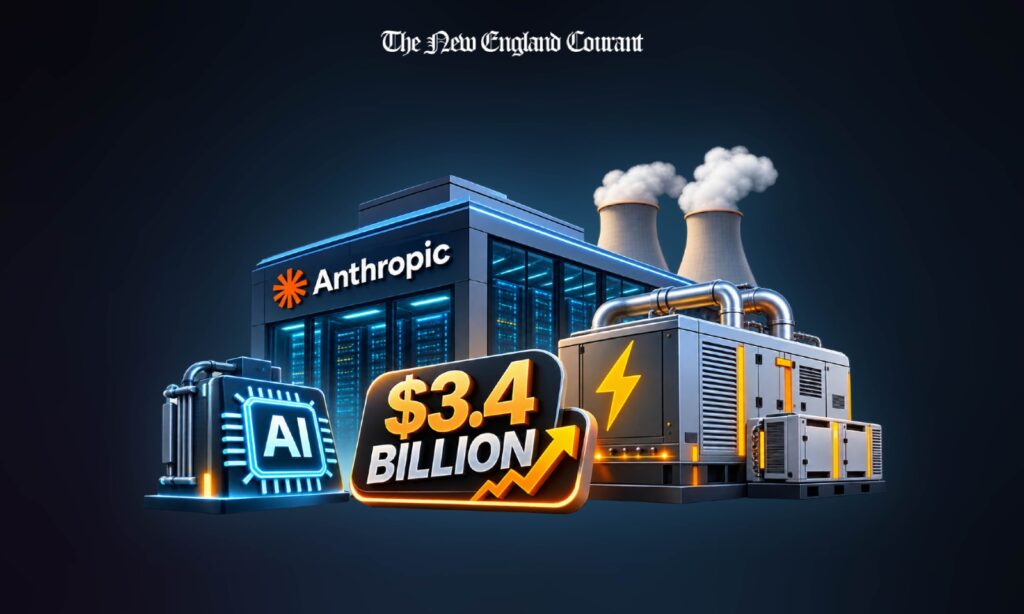
Anthropic has reportedly committed approximately $3.4 billion to secure 1.7 gigawatts of gas-fired generator capacity for its expanding artificial intelligence infrastructure, highlighting how access to electricity is becoming a major competitive advantage in the global AI industry.
The agreement, first reported by the Financial Times on Sunday, November 8, 2026, involves generator commitments originally placed with OnePWR Solutions, a San Antonio-based equipment supplier. Reuters published its report on the same date, confirming that the arrangement had been reported by the Financial Times but stating that it could not independently verify the details. Although the story has appeared in November 9 news coverage, its original publication date was November 8.
According to the Financial Times, Anthropic agreed in late September to take over commitments for 1.7 gigawatts of heavy-duty generators from OnePWR. The equipment consists of gas-fired units manufactured by Caterpillar, with the reported agreement also covering engineering and construction capabilities needed to install the systems.
The arrangement does not mean Anthropic acquired OnePWR Solutions itself. The supplier’s employees also did not transfer to the AI company. Instead, Anthropic reportedly took over the existing equipment commitments, securing access to generation capacity that could otherwise have been difficult to obtain amid growing demand and lengthy manufacturing lead times.
The reported purchase is significant because it illustrates a change in how major AI developers are approaching infrastructure. Traditionally, data centre operators have relied heavily on electricity supplied through utility companies and national or regional power grids. However, the rapid expansion of AI computing has created demand for electricity that existing infrastructure cannot always deliver quickly enough.
Training and operating advanced AI models requires large computing clusters containing thousands of specialised processors. These systems need continuous electricity, reliable cooling and supporting infrastructure. As AI services attract more users and companies expand their computing capacity, securing sufficient power has become an increasingly important part of long-term technology planning.
Anthropic’s reported agreement suggests that the company is seeking greater control over this critical resource rather than depending entirely on external electricity suppliers. A generator capacity of 1.7 gigawatts represents a substantial power commitment, although the figure describes potential generation capacity rather than electricity already being produced or consumed. The equipment is also expected to become available over time, rather than providing the entire capacity immediately.
The move comes as competition for power-generation equipment intensifies. AI developers are competing not only for advanced chips and data centre sites but also for turbines, generators, electrical components and the engineering services required to bring facilities online. Manufacturing delays can become a major obstacle when companies need infrastructure to support rapidly growing AI businesses.
For Anthropic, securing generator commitments could help reduce uncertainty around future electricity availability. The company develops the Claude family of AI models, whose growing demand has increased its need for computing resources. Reuters has previously reported that Anthropic expects to spend more than $500 billion over the next decade building AI infrastructure. That figure reflects the scale of its reported long-term ambitions, not an amount already spent.
The financial implications are considerable. Building dedicated power infrastructure requires substantial upfront capital, and generator purchases are only one part of the overall cost. Companies must also account for fuel procurement, installation, maintenance, land, electrical systems, cooling and regulatory approvals. The economics will depend on how frequently the generators operate, the cost of natural gas and the ability to match electricity supply with data centre demand.
For energy companies and equipment manufacturers, the growing interest in dedicated power generation could create significant commercial opportunities. Suppliers of industrial generators, gas infrastructure, electrical equipment and engineering services may benefit as technology companies seek alternatives to conventional grid connections. Caterpillar’s involvement in the reported generator orders also illustrates how demand for AI computing is creating business opportunities beyond the traditional technology sector.
The wider consequences for electricity markets could be more complicated. If large technology companies increasingly develop their own generation capacity, they may reduce their immediate dependence on local utilities. However, dedicated power projects still require fuel infrastructure, land and connections to supporting energy systems. Their development could also influence regional demand for natural gas and affect how utilities plan future generation and grid investments.
The environmental implications are equally important. Natural-gas generators can provide dispatchable electricity, allowing operators to produce power when required rather than relying exclusively on weather-dependent renewable sources. However, burning natural gas releases carbon dioxide, while extraction and transportation can also produce methane emissions. The climate impact will depend on the equipment’s efficiency, operating hours, fuel supply and any additional emissions controls.
The deal therefore raises questions about how AI companies intend to balance rapid infrastructure expansion with their environmental commitments. Securing electricity may solve an immediate operational problem, but long-term dependence on fossil-fuel generation could expose companies to higher emissions, regulatory pressure and changing energy costs. Renewable electricity, battery storage, nuclear power and other lower-carbon technologies may become increasingly important as AI infrastructure expands.
For businesses using AI services, the investment could eventually support greater computing availability and help providers meet demand for increasingly complex applications. More reliable power infrastructure may also reduce the risk of electricity shortages interrupting data centre operations. However, the benefits for customers will depend on how effectively companies translate additional generation capacity into operational computing resources.
Investors are likely to view the agreement as evidence of the enormous capital requirements behind the AI industry. The move may strengthen Anthropic’s ability to secure essential infrastructure, but it also demonstrates the financial risks associated with competing at the highest level of AI development. Spending billions on power equipment before all future demand and revenue are established requires confidence that the market for advanced AI services will continue expanding.
Governments and regulators will also have to consider how dedicated power generation affects energy policy. Large private investments can accelerate infrastructure development and reduce pressure on some grid connections, but they raise questions about emissions, local air quality, fuel availability and the allocation of energy resources. Policymakers will need to ensure that the growth of private AI infrastructure does not create additional costs or environmental burdens for surrounding communities.
Anthropic’s reported generator agreement reflects a broader transformation in the technology industry. Competition in artificial intelligence is no longer limited to developing better models or acquiring faster processors. Companies increasingly need to secure the physical resources that make advanced computing possible, particularly electricity.
Whether this strategy proves financially and environmentally sustainable will depend on how effectively AI developers manage the costs of power generation, reduce emissions and convert infrastructure investments into commercially valuable services. For now, the reported agreement demonstrates that access to electricity is becoming one of the defining challenges of the AI expansion.
