

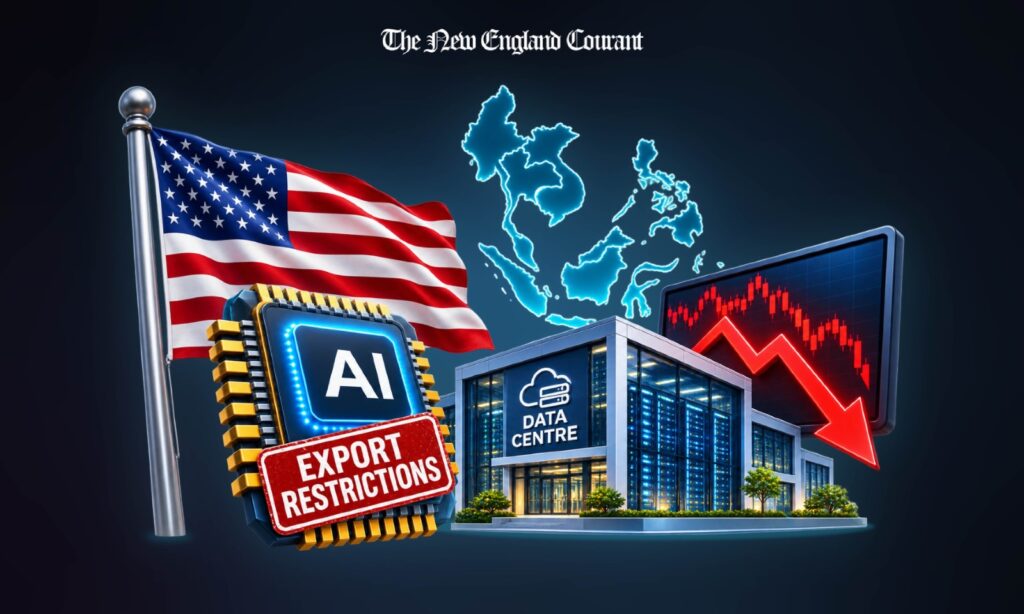
Shares of data centre operators, semiconductor suppliers and infrastructure companies across Southeast Asia fell sharply on Tuesday after the United States introduced new restrictions on advanced AI chip exports, raising concerns about the future of the region’s rapidly expanding data centre industry.
The new US measures target advanced computing chips and overseas data centres that provide significant computing capacity to companies headquartered in China. The restrictions are intended to prevent Chinese businesses from accessing powerful American AI hardware through facilities located in countries where direct chip exports to China are already restricted.
Under the new rules, shipments of covered advanced semiconductors to Malaysia, Singapore, Thailand, Indonesia and Brazil require US export licences. Data centre operators and other businesses involved in supplying advanced computing capabilities may also face additional customer-verification and compliance requirements.
The announcement triggered a broad sell-off in regional technology and infrastructure stocks. In Malaysia, YTL Power shares dropped nearly 10%, while parent company YTL Corporation fell 8%. Chip industry services provider Frontken lost around 4%.
Other Malaysian companies linked to data centre construction and infrastructure, including Sunway Construction, Tenaga Nasional, Gamuda and Samaiden, also recorded declines.
Singapore’s semiconductor-related stocks came under pressure as well. Frencken fell 3.91%, while semiconductor testing company AEM declined 2.9%. Suppliers of data centre components, cooling systems, printed circuit boards and energy infrastructure in other Asian markets also experienced losses.
The immediate concern for investors is that tighter licensing requirements could increase project costs, delay equipment deliveries and make it harder for some data centres to secure customers. Businesses that rely heavily on Chinese AI companies or less transparent graphics processing unit (GPU) rental arrangements may face particularly demanding compliance checks.
Analysts at MBSB Bank warned that facilities serving Chinese AI customers could experience longer licensing and customer-verification processes. Such delays could affect revenue expectations and the financial planning of operators with large investments in advanced computing infrastructure.
The restrictions come at a sensitive time for Southeast Asia’s data centre market, which has attracted billions of dollars in international investment as demand for artificial intelligence, cloud computing and digital services continues to grow.
Malaysia has approved approximately 385.7 billion ringgit ($95 billion) in data centre-related investments since 2021, according to figures cited by Reuters from the country’s trade ministry. Thailand had 42 data centres with a combined IT load of 3,400 megawatts and investments worth around 750 billion baht ($22.6 billion) as of February 2026.
Indonesia’s data centre market was valued at approximately $2.81 billion in 2025.
The expansion has also supported economic activity beyond the technology sector. Singapore raised its 2026 economic growth forecast to between 4.5% and 5.5% in August, citing the strength of the AI industry. In Malaysia, growing data centre development contributed to a 6% expansion in the construction sector during the third quarter.
Singapore’s government said on Tuesday that it was examining the new US measures and discussing their potential impact with affected businesses and American authorities.
In a joint statement, the Ministry of Digital Development and Information and the Ministry of Trade and Industry said Singapore would work to understand the scope and implementation of the restrictions while seeking to preserve trusted access to advanced semiconductors for legitimate businesses.
The government also stressed that it would not allow companies to use Singapore’s business environment to circumvent or violate other countries’ export-control laws.
The new rules could create additional challenges for data centre operators that serve international customers. Companies may need to strengthen checks on customer ownership, corporate structures and the intended use of computing resources to demonstrate that their facilities are not indirectly supplying restricted access to Chinese businesses.
For investors, the impact may extend beyond companies that directly import AI chips. Data centre projects depend on a wider network of suppliers, including construction firms, electricity providers, cooling-system manufacturers, equipment suppliers and semiconductor service companies. Delays or changes in investment plans could therefore affect several parts of the regional economy.
However, the new restrictions do not necessarily mean that Southeast Asia’s data centre expansion will stop. Demand for cloud services, AI applications and computing capacity remains strong, and operators may seek customers in other markets to reduce their dependence on Chinese businesses.
The longer-term effect will depend on how strictly Washington implements the licensing requirements, how quickly companies can meet the new compliance standards and whether governments in the region can secure clear arrangements for legitimate technology investment.
For Southeast Asia, the challenge is to maintain its position as a major destination for global data centre investment while complying with increasingly complex US-China technology restrictions.
