

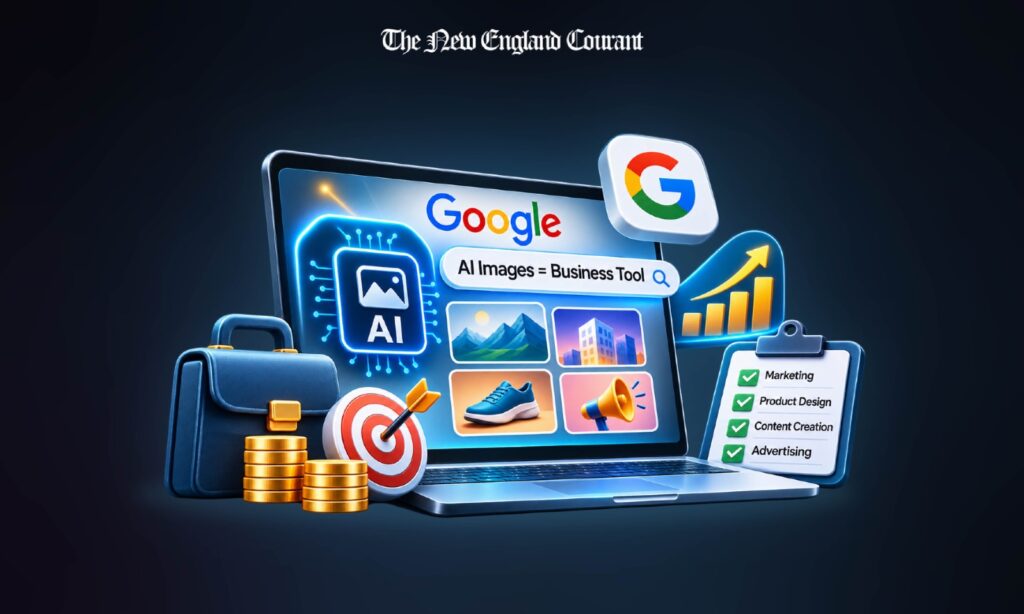
Artificial intelligence image generators are being used for far more than viral social media pictures, wit and marketing materials, product visualisation and e-commerce, architectural design, and educational and h businesses, educators and online sellers increasingly turning to the technology for practical work. A new Google research study suggests that AI image generation is developing into a tool for marketing, product design, education and architectural planning.
The study examined 2.1 million conversations involving Google’s Gemini Nano Banana image generation models, offering a closer look at how people use AI to create and edit visual content. Rather than focusing only on popular online trends, the researchers identified five broad areas of use: social and viral sharing, brandtechnical information.
The research was conducted by Google researchers using a framework called Urania, which analyses patterns in chatbot conversations. According to the paper, the system was designed to identify general usage trends without researchers examining individual prompts or uploaded and generated images. It uses differential privacy techniques to help protect users’ information while producing aggregated insights.
The findings challenge the assumption that AI image generators are primarily entertainment tools. Although social media content remains an important use case, the research identified substantial activity connected to commercial and practical tasks. Users are creating promotional graphics, refining brand identities, visualising products and producing educational illustrations.
Marketing emerged as a particularly important area. The researchers found that people using image generation for marketing were more likely to provide detailed instructions about image composition, text placement, typography, lighting and the elements that should or should not appear. This suggests that users are increasingly treating AI image generators as design assistants rather than simply asking them to produce attractive pictures.
Another notable finding was the strong involvement of individuals, small businesses and side projects in marketing-related conversations. Many requests involved fictional, new or unrecognised brands instead of established companies. This indicates that entrepreneurs and smaller businesses may be using AI to develop visual identities and promotional materials without immediately hiring a professional design team.
The technology is also being used beyond creating images from scratch. Researchers identified requests to update logos, change colours and wording, refine existing designs and develop promotional assets for different platforms. These capabilities could make it easier for businesses to adapt their visual content for websites, online stores, social media campaigns and advertising.
For smaller companies operating with limited budgets, this could reduce the time and cost involved in producing basic marketing materials. A business owner may be able to develop an initial product advertisement or campaign concept independently before asking a designer to refine it. However, AI-generated output still requires human review, particularly where brand consistency, accurate product representation and readable text are important.
E-commerce is another area where image generation could have practical commercial value. Retailers can use visualisation tools to explore product presentation, create alternative backgrounds and develop promotional concepts. This may help smaller sellers produce more varied marketing content, although generated images should not misrepresent a product’s actual appearance, size, features or condition.
The study also identified architectural and spatial design as a distinct category. AI-generated visuals can help users explore room layouts, interior styles and design concepts before committing to physical changes. While these images can support early-stage planning and communication, they should not be treated as substitutes for technical drawings, structural assessments or professional architectural advice.
Educational and technical information represented another important use case. People are using image generation to create explanatory visuals, instructional materials and illustrations that can make complex subjects easier to communicate. Teachers, trainers and businesses could benefit from producing customised visual resources for different audiences, although factual and technical accuracy still needs to be checked.
The researchers also examined how people interact with image generators after submitting their initial requests. Users frequently specify artistic styles, adjust composition and request changes to existing images. In some cases, they are more likely to ask the system to generate an entirely new version than to make a minor adjustment. This highlights an important limitation: producing a satisfactory image may still require experimentation and several rounds of prompting.
Interestingly, memes and humorous image formats were among the least prevalent features identified within the social and viral category. Requests involving people were much more common, appearing in nearly 80% of conversations in that category, according to the study. This suggests that personal and social image creation is a significant part of how users interact with these tools, rather than humour and viral content alone.
The privacy aspect of the research is also important. AI image generators can receive personal photographs, family pictures and other sensitive visual material. By analysing aggregated patterns in conversations without directly inspecting individual images or prompts, Google’s approach offers one possible way to study product usage while reducing exposure to personal content. However, differential privacy does not mean that every aspect of using an AI image service is automatically private. Users should still review the service’s data policies and understand how their information may be processed.
For technology companies, the findings provide useful evidence about which features people may value as AI image generation becomes part of everyday digital work. Improvements in image editing, text rendering, composition control and consistency could make these tools more useful for professional applications. The research may also help developers prioritise features based on actual usage patterns rather than assumptions about what consumers want.
For businesses and creative professionals, the findings point towards a changing division of work rather than the immediate disappearance of traditional design roles. AI can help produce early concepts and routine visual assets, while human professionals remain important for creative direction, quality control, originality and complex brand decisions.
The study does not establish that AI image generators are replacing professional designers or that every business can achieve professional results without specialist support. It provides a descriptive snapshot of conversations involving Nano Banana models, not a measure of productivity, commercial success or the quality of the images produced.
Nevertheless, the scale and range of activity identified by Google show that AI image generation is moving beyond online experimentation. As the technology becomes easier to use, its commercial value may increasingly depend on how reliably it supports real tasks, from product marketing to education and design. The next stage of competition will likely be shaped not simply by which system creates the most impressive image, but by which one helps people produce accurate, useful and consistent visual content.
