

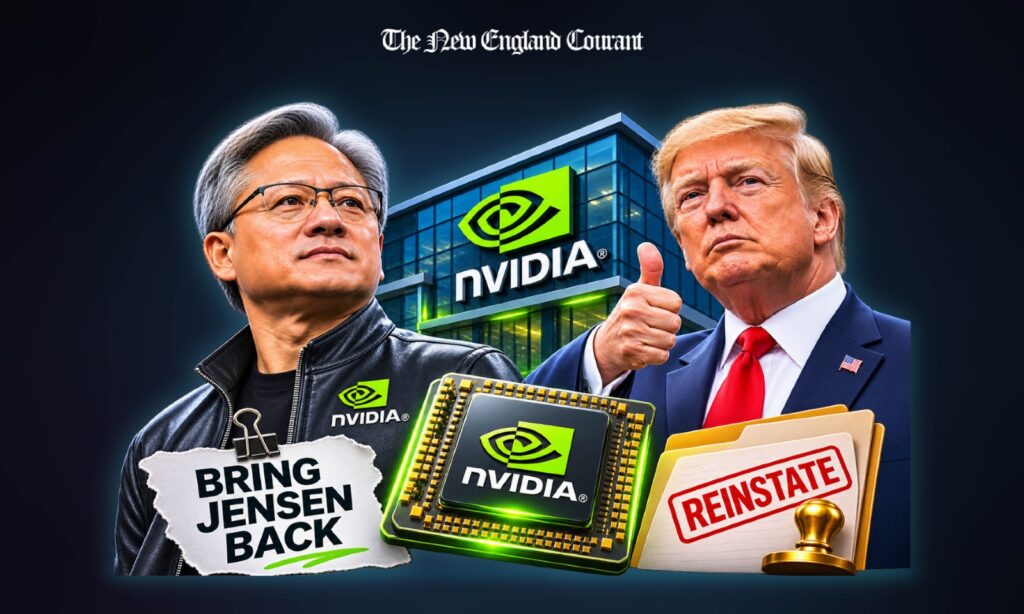
A growing campaign to bring Jensen Huang back as Nvidia’s chief executive has gained support from US President Donald Trump and several major technology figures. However, the company’s board is reportedly unwilling to reverse his departure, leaving one of the world’s most influential technology businesses facing an unusual leadership dispute.
Trump said on Monday that he would not mind seeing Huang return to the position, adding his support to a campaign backed by SpaceX and Tesla chief executive Elon Musk and Epic Games CEO Tim Sweeney.
The campaign, known as Stand With Jensen, has attracted more than 180,000 signatures, according to figures reported by Reuters. Its supporters include people identifying themselves as current and former Nvidia employees, shareholders, business partners and technology industry figures.
An open letter published by the campaign asks Nvidia’s board to reconsider Huang’s removal while an independent investigation establishes the facts. Supporters argue that the company’s co-founder should not have been forced out without what they consider meaningful due process.
Despite the growing public pressure, Nvidia’s board is not considering reinstating Huang, according to three people familiar with the matter who spoke to Reuters. The BBC has also reported that the board is not interested in bringing him back.
The controversy follows Huang’s resignation on November 11, after reports emerged of relationships involving employees and a Chinese businesswoman, Alice Huang, who is suspected of having links to Chinese intelligence. The allegations have raised questions about corporate governance, potential conflicts of interest and whether sensitive business information could have been exposed.
The suspected intelligence connection remains under investigation and has not been established as a proven finding. China has denied that Alice Huang is a spy, while US intelligence agencies are reportedly examining her relationship with Beijing and whether information was shared with Chinese authorities.
Nvidia’s leadership transition is already formally documented. In a November 12 filing with the US Securities and Exchange Commission, the company confirmed that its board had accepted Huang’s resignation and appointed Chief Financial Officer Colette Kress as interim CEO. Harvey Jones was also appointed board chair as Nvidia began searching for a permanent successor.
Trump’s support for Huang contrasts with the more cautious position taken by some policymakers and investors. Treasury Secretary Scott Bessent has reportedly favoured recruiting Nvidia’s next chief executive from outside the company, while governance specialists have warned that reinstating Huang before the investigations are complete could expose the business to legal and reputational risks.
The dispute has also divided investors. Some prominent shareholders, including Altimeter Capital founder Brad Gerstner and Atreides Management’s Gavin Baker, have urged the board to keep the possibility of Huang’s return open until more information becomes available.
Musk has argued that Huang’s departure could put important commercial relationships at risk. In a post on X, he said some major Nvidia technology deals depended on personal relationships and agreements built around Huang, rather than formal contracts.
That argument reflects Huang’s unusually influential role in Nvidia’s development. He co-founded the company in 1993 and helped transform it from a graphics-chip manufacturer into a central supplier of processors and systems used to develop and operate artificial intelligence models.
His relationships with technology companies, cloud providers, investors and semiconductor suppliers have become an important part of Nvidia’s business network. A permanent leadership change could therefore raise questions about succession planning and whether the company can maintain the same level of confidence among customers and partners.
The leadership crisis is unfolding alongside growing scrutiny of Nvidia’s international business and US restrictions on advanced AI chip exports to China.
The Trump administration has introduced additional export-control requirements targeting overseas data centres that could provide Chinese companies with access to restricted computing power. The rules cover facilities and chip shipments involving countries including Singapore, Malaysia, Thailand and Indonesia.
The issue has attracted attention because Singapore has served as an important commercial hub for Nvidia’s regional operations. US authorities are examining concerns that advanced chips supplied through overseas businesses could potentially reach restricted Chinese customers.
Huang had previously argued against broad restrictions on selling advanced AI chips to China, saying access to international markets was important for US competitiveness. His departure has therefore added another layer of uncertainty to the debate over the country’s semiconductor export policy.
For Nvidia, the immediate challenge is to reassure investors that its operations, customer relationships and product development plans remain stable without its long-time chief executive. The company has said its experienced leadership team will continue executing its strategy under Kress.
Investors will also be watching Nvidia’s third-quarter fiscal 2027 results, scheduled for November 17. The earnings announcement will provide an opportunity to assess the company’s financial performance and hear how its interim leadership intends to manage the transition.
Although the campaign demonstrates Huang’s continued influence across Silicon Valley, public support alone cannot determine Nvidia’s leadership. The board must weigh shareholder interests, corporate governance responsibilities and the outcome of ongoing investigations before making any decision.
For now, Nvidia appears focused on moving forward without its co-founder, despite growing calls from influential figures for his return.
