

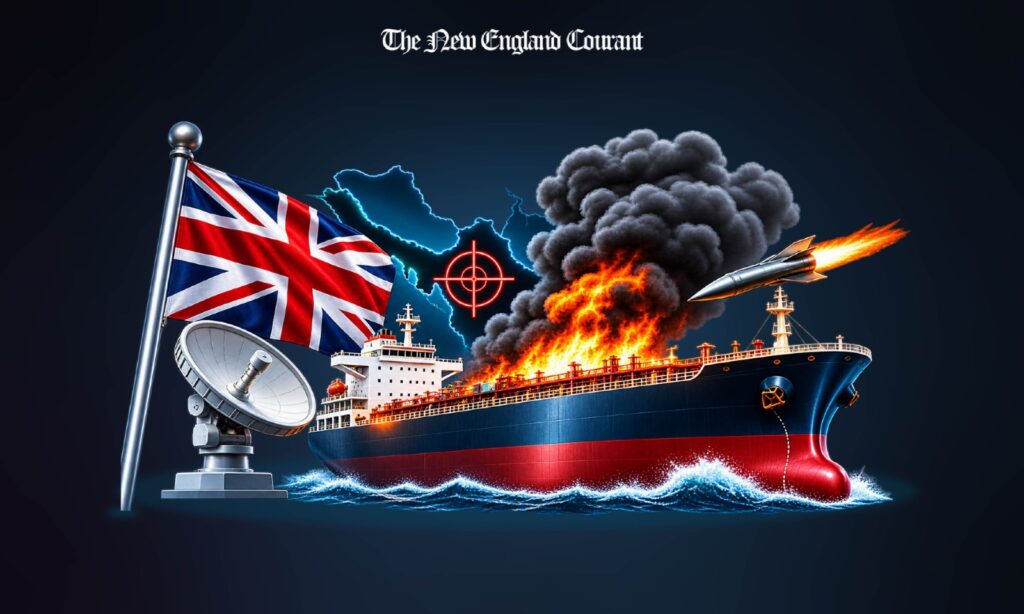
A tanker sailing out of the Persian Gulf was struck by an unidentified projectile while passing through the Strait of Hormuz on Monday, November 16, triggering a fire in its engine room and raising fresh concerns about the safety of commercial shipping in one of the world’s most important energy corridors.
The UK Maritime Trade Operations (UKMTO), a British maritime security agency, confirmed the incident in an official warning issued on Monday. According to information provided by the vessel’s company security officer, the tanker was hit at approximately 05:58 UTC while travelling outbound through the strait.
The strike caused a fire in the ship’s engine room. However, UKMTO said no casualties had been reported and all crew members had been accounted for. The extent of the damage and any possible environmental impact remained unknown when the warning was issued.
Authorities have not identified the vessel, its flag, its cargo or the source of the projectile. No group or country has been publicly identified as responsible, and investigations into the incident are continuing.
UKMTO advised other commercial vessels to exercise caution while transiting the waterway and report suspicious activity to maritime authorities. The warning highlights the security risks facing shipping companies operating in the region, where attacks on commercial vessels have become an increasing concern.
The latest incident comes amid a series of reported attacks involving tankers in and around the Strait of Hormuz. On November 11, UKMTO reported that a tanker had been struck by an unidentified projectile in the engine room northwest of Ras Al Khaimah, United Arab Emirates. Its crew were evacuated safely while firefighting operations continued.
Other incidents have also been reported in recent days. Iranian state media and the Revolutionary Guards have attributed several tanker explosions and fires to naval mines, claiming that some vessels used unauthorised routes. However, Reuters has reported that these claims could not be independently verified.
The repeated incidents are increasing uncertainty for shipping companies, insurers and energy traders. The Strait of Hormuz connects the Persian Gulf with the Gulf of Oman and is a critical route for international oil and liquefied natural gas shipments. A significant disruption to traffic through the waterway could affect energy supplies and increase transportation costs across global markets.
For oil traders, attacks on tankers can create an additional security premium in crude prices. Even when supply volumes remain unchanged, concerns about possible damage to vessels, shipping delays or wider military escalation can influence market expectations. However, the latest incident alone does not establish that global oil supplies have been disrupted.
Shipping companies may also face higher insurance costs and pressure to review their routes, security arrangements and crew safety procedures. If attacks continue, operators could delay voyages, seek alternative arrangements where possible or require additional security measures before entering the region.
The consequences could extend to consumers and businesses beyond the Middle East. Higher freight and insurance costs can eventually feed into the prices of imported fuel, industrial materials and other goods, particularly in economies that rely heavily on energy shipments passing through the Gulf.
The incident also presents a challenge for governments and maritime security organisations seeking to protect commercial shipping without escalating regional tensions. Identifying the source of attacks and maintaining safe passage through the strait will remain important for countries dependent on reliable energy supplies.
For now, the immediate priority is assessing the damage to the affected tanker and confirming whether there has been any environmental impact. With the vessel’s identity and the origin of the projectile still unknown, the latest attack adds to concerns about the security of shipping through the Strait of Hormuz.
