

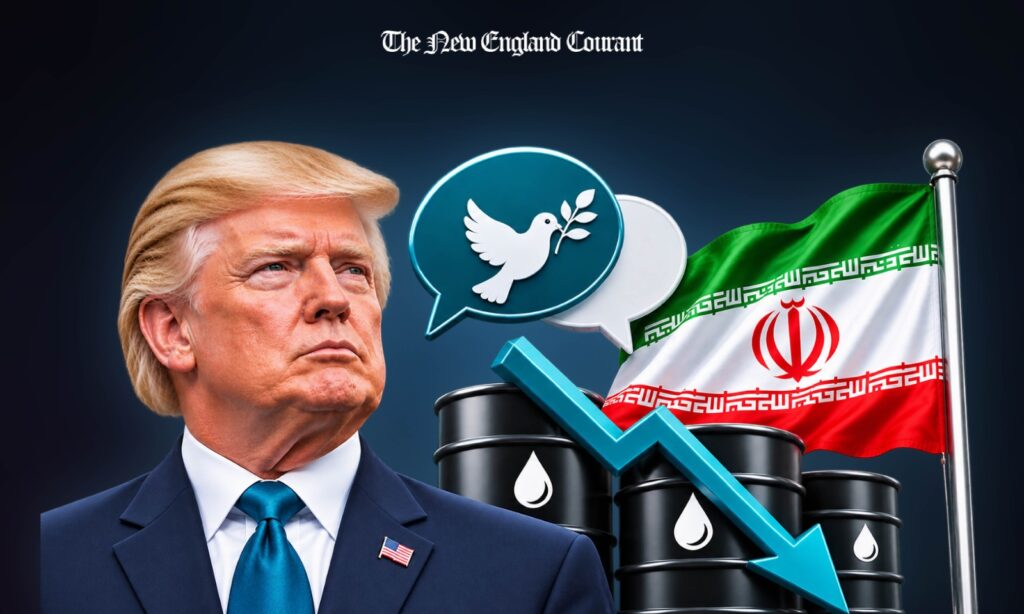
US President Donald Trump has indicated that further American military strikes against Iran are unlikely in the immediate future, saying the country’s military capabilities have been effectively defeated and that diplomatic efforts are gaining momentum. However, Washington is maintaining its naval blockade and has warned that American forces remain prepared to resume military action if circumstances change.
Speaking to reporters at the White House on Monday, November 9, Trump described Iran as militarily weakened and said the United States was maintaining the current situation partly in response to requests from neighbouring countries. He characterised renewed attacks as “highly unlikely”, while stressing that American forces remained ready to act if necessary.
The comments suggest a possible shift towards containing the conflict rather than launching another major offensive. They do not, however, represent a formal declaration that the war has ended, nor do they confirm that Washington and Tehran have reached a peace agreement.
Trump’s latest remarks followed a meeting with Qatari Prime Minister Sheikh Mohammed bin Abdulrahman Al Thani at the White House. Qatar has played an important intermediary role in diplomatic efforts between the United States and Iran, helping communicate proposals and address disagreements over Tehran’s nuclear programme and the conditions required to end the conflict.
Trump described the discussions as positive, while Qatar’s prime minister said he had held constructive talks with the US president and Vice-President JD Vance about reaching an agreement and restoring regional stability.
Despite these diplomatic signals, significant obstacles remain. US Secretary of State Marco Rubio previously indicated that negotiations had made limited progress and that an immediate breakthrough was unlikely. Iranian officials have also expressed doubts about earlier statements from Trump suggesting the conflict could soon be resolved.
The United States has not withdrawn its military pressure. Trump indicated that the naval blockade affecting Iranian ports would remain in place, presenting it as part of the effort to protect regional allies and limit Iran’s ability to conduct military operations. The administration has also warned that additional targets could be considered if hostilities resume.
The continued blockade is particularly significant because the Strait of Hormuz is one of the world’s most important energy shipping routes. Disruptions in and around the waterway can affect crude oil and other energy shipments, creating consequences for import-dependent economies well beyond the Middle East.
Oil markets have responded positively to the possibility of de-escalation. Brent crude prices fell further on Tuesday, November 10, trading at approximately $91.88 a barrel by 0246 GMT, while US West Texas Intermediate declined to around $86.07. Reuters reported that Brent had already fallen 5.85 per cent during the previous trading session as investors reassessed the likelihood of further military escalation.
The decline reflects changing expectations about the risk of prolonged supply disruptions rather than confirmation that regional shipping has returned to normal. Reuters reported that Brent had fallen approximately 22 per cent from its six-month high of $118 reached on October 30, as fears of a renewed US offensive eased.
For energy-importing countries, lower crude prices could eventually reduce pressure on fuel costs, transport expenses and inflation. Businesses that rely heavily on shipping, logistics and energy may also benefit if the decline continues. However, consumers should not assume that wholesale oil-price movements will immediately translate into lower petrol prices, as domestic taxes, currency movements, refining costs and distribution margins also influence retail fuel prices.
The diplomatic developments are unfolding against a difficult political backdrop in Washington. The Republican Party suffered significant setbacks in the November midterm elections, with dissatisfaction over the Iran conflict emerging as an important issue in the political debate. The war’s economic consequences, particularly pressure on energy prices, have increased scrutiny of the administration’s approach.
The political pressure has also extended to the defence establishment. Republican Congressman Thomas Massie has moved to force a House of Representatives vote seeking the impeachment of Defence Secretary Pete Hegseth over his handling of the conflict. Trump has defended Hegseth and dismissed the effort as a sham. The proposal faces considerable political obstacles, although it highlights growing disagreements over the administration’s military strategy.
For governments across the Gulf, the possibility of a diplomatic settlement would offer an opportunity to reduce security risks and restore confidence in regional trade and transport. Saudi Arabia, Qatar and the United Arab Emirates have all faced security threats linked to the conflict, while disruptions to aviation and maritime activity have affected businesses and travellers.
For investors, the situation remains highly sensitive to political statements and developments around the Strait of Hormuz. A sustained reduction in military activity could ease the geopolitical risk premium built into oil prices and improve confidence in regional markets. Conversely, renewed attacks on shipping or a breakdown in negotiations could quickly reverse the recent decline.
The central uncertainty is whether Trump’s more restrained language will lead to a durable diplomatic arrangement. The United States appears less inclined to launch further major strikes for now, but its naval blockade and military readiness indicate that pressure on Iran is continuing.
Until Washington and Tehran reach an agreement and maritime security improves, the conflict will remain a significant source of uncertainty for global energy markets, regional governments and international businesses.
